Monitoring the Frontier
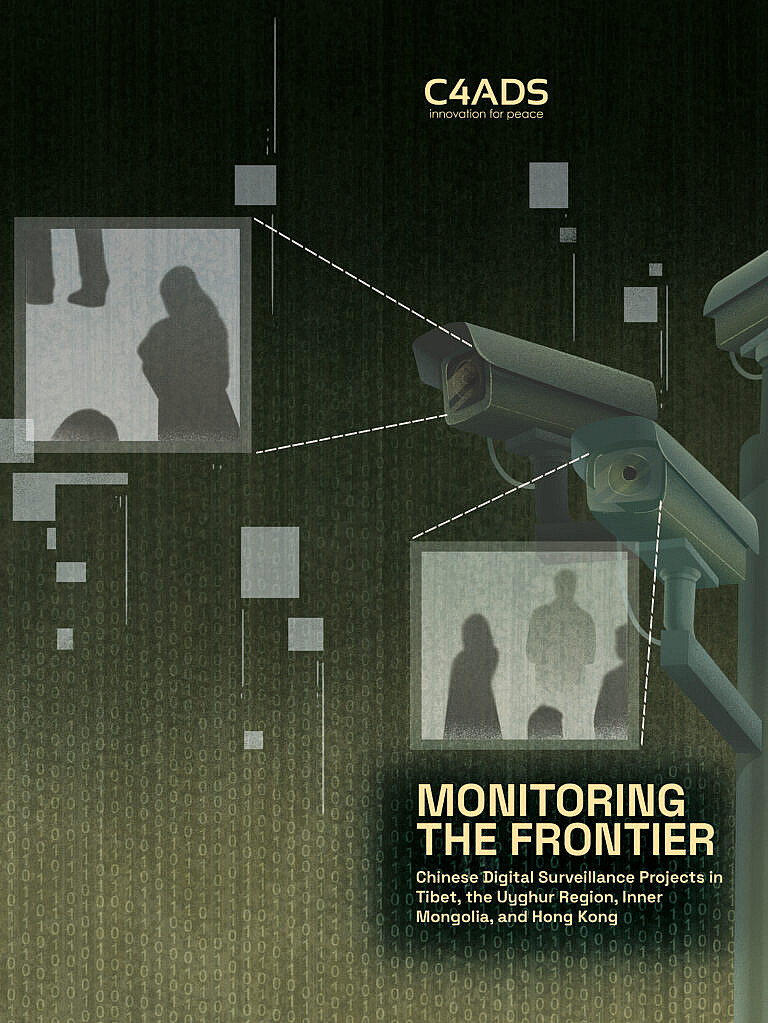
The same architecture of surveillance and control underpins China’s presence in Tibet, the Uyghur region, Inner Mongolia, and Hong Kong, built on procurement networks designed to stay a step ahead of sanctions and export controls.
Executive Summary #
Using an original dataset built from government and corporate records, this report maps digital surveillance supply chains across four regions governed by China: the Tibet Autonomous Region (Tibet/TAR), the Xinjiang Uyghur Autonomous Region (XUAR/ the Uyghur region), Inner Mongolia Autonomous Region (Inner Mongolia), and Hong Kong. This data offers a novel lens on China’s surveillance apparatus because, unlike secondary reporting or victim testimony, government records document the state’s own purchasing decisions and reveal which companies and technologies underpin its infrastructure.
Analysis limited to a single region misses the pervasiveness of China’s digital surveillance architecture. While these four regions are not the only ones affected by China’s repressive surveillance system, this report focuses on them due to the acute impact that surveillance has had on those populations. Tibet is often recognized as the prototype and the Uyghur region as the scale-up for China’s repression of ethnic minorities and mass surveillance. These tools and tactics extended into Hong Kong under a nominally distinct legal system, and have also spread into Inner Mongolia, which has garnered significantly less attention.
China’s digital surveillance apparatus has evolved from Maoist-era grassroots social control to a high-tech infrastructure enabled by artificial intelligence (AI), consisting of high-resolution cameras, biometric data collection, and predictive policing platforms. The Chinese Communist Party’s (CCP) “Five Poisons” (五毒) framework designates ethnic and religious minority populations as well as pro-democracy activists as existential threats and provides the ideological foundation for targeted surveillance in China. State-led initiatives like “Sharp Eyes” (雪亮工程) enhance the reach and scale of targeted digital surveillance. Notably, the extent of Chinese state surveillance in Inner Mongolia documented by C4ADS shows that the CCP’s surveillance and repression patterns are not confined to the populations named in the Five Poisons framework. However, the Five Poisons designation still identifies the populations Beijing views as posing the greatest threat to its national security.
Chinese government records show four recurring elements in the state’s repressive surveillance apparatus: (1) public security bureaus (PSBs) are the primary procurers of surveillance equipment, (2) PSBs are acquiring AI-enabled biometric technology, (3) projects rely largely on domestic distributors (especially the three largest telecommunications companies), and (4) U.S.-sanctioned manufacturers such as Uniview and Hikvision remain major manufacturers of surveillance equipment supplied to China.
China’s surveillance technology capacity was built by leveraging Western technology and partnerships, but a large domestic industry now exists comprising the world’s largest surveillance manufacturers and exporters. This report’s findings show that as domestic capacity grows, it increasingly limits the reach of sanctions and export controls that target only named foreign manufacturers, creating a need to leverage additional tools aimed at distributors and end users, discussed further in the Recommendations. However, foreign companies remain embedded in the supply chain.
Through government acquisition systems, global supply chains may still be more widely complicit in the repression of ethnic minority groups and political dissidents. Mapping these supply chains and understanding the patterns of how China continues to power its repressive surveillance apparatus is a precondition for financial, legal, and reputational accountability. Disruption requires knowing which actors to target, how they are connected, and the ways they operate. This report identifies the leading domestic suppliers of surveillance hardware named in relevant contracts across the four regions, offering an initial snapshot of the companies most central to this market. Because the U.S.-sanctioned manufacturers discussed in this report operate on a global scale, corporate due diligence and know-your-customer (KYC) standards are essential tools for preventing further complicity in state-sponsored repression.
Download the Executive Summary in Chinese #