Anchors Away
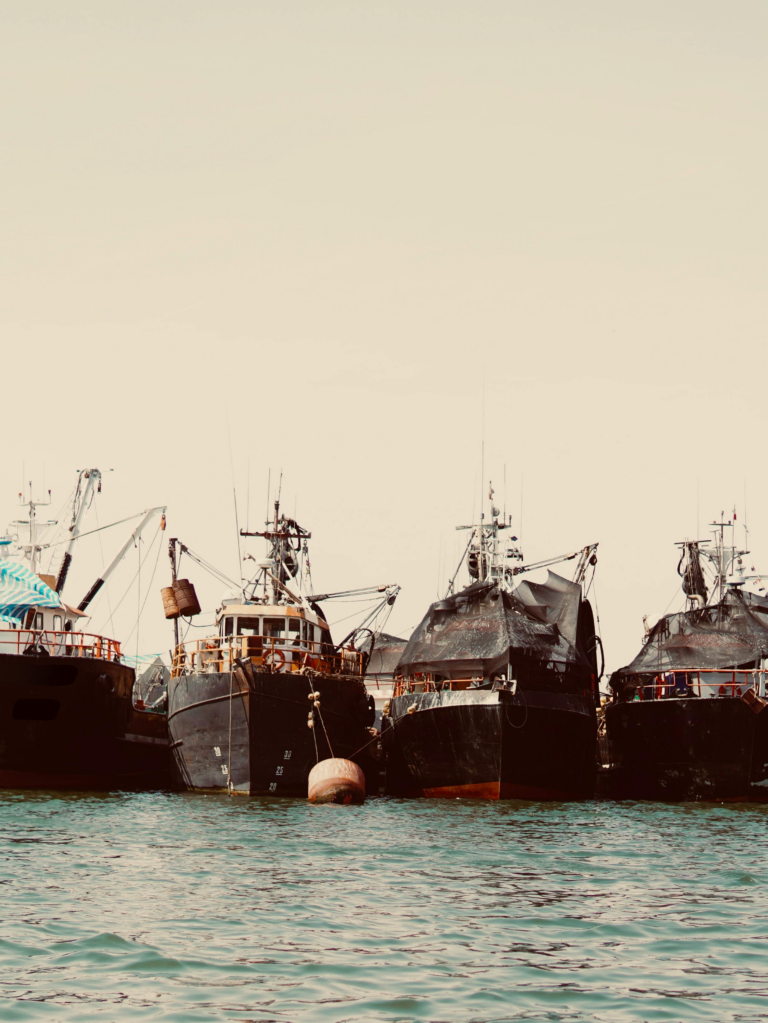
Behind every vessel on the high seas is an owner who profits from its operations and should be held accountable when those operations cross a line. Finding that person, the ultimate beneficial owner (UBO), is rarely straightforward.
Shipowners often structure their holdings across multiple jurisdictions, motivated by tax incentives and minimal corporate transparency requirements.[1] They often incorporate several offshore entities and shift vessel ownership between them to mask their vessel’s UBO.[2] Vessels may even operate under the flag of yet another country, adding additional layers between the ship and its beneficial owners.[3]
Investigators’ ability to follow this ownership chain depends entirely on how accessible corporate information is in each jurisdiction it touches, and that varies greatly. Some countries maintain robust, searchable public registries; others, whether due to resource constraints or intentional secrecy, do not share this data or collect it at all. Owners who understand this landscape build structures designed to exploit these gaps.[4]
The consequences span maritime industries. Opaque ownership chains enable illegal, unreported, and unregulated (IUU) fishing, forced labor, and sanctions evasion at sea. C4ADS has examined such networks in reports including Sea Shells and Oil and Water. Below, we highlight three ownership and flagging patterns currently in use on the high seas. Each jurisdiction chain is linked to vessels with demonstrated risk factors in their respective industries, and each illustrates the international loopholes that vessel owners may use to pursue illicit activities.
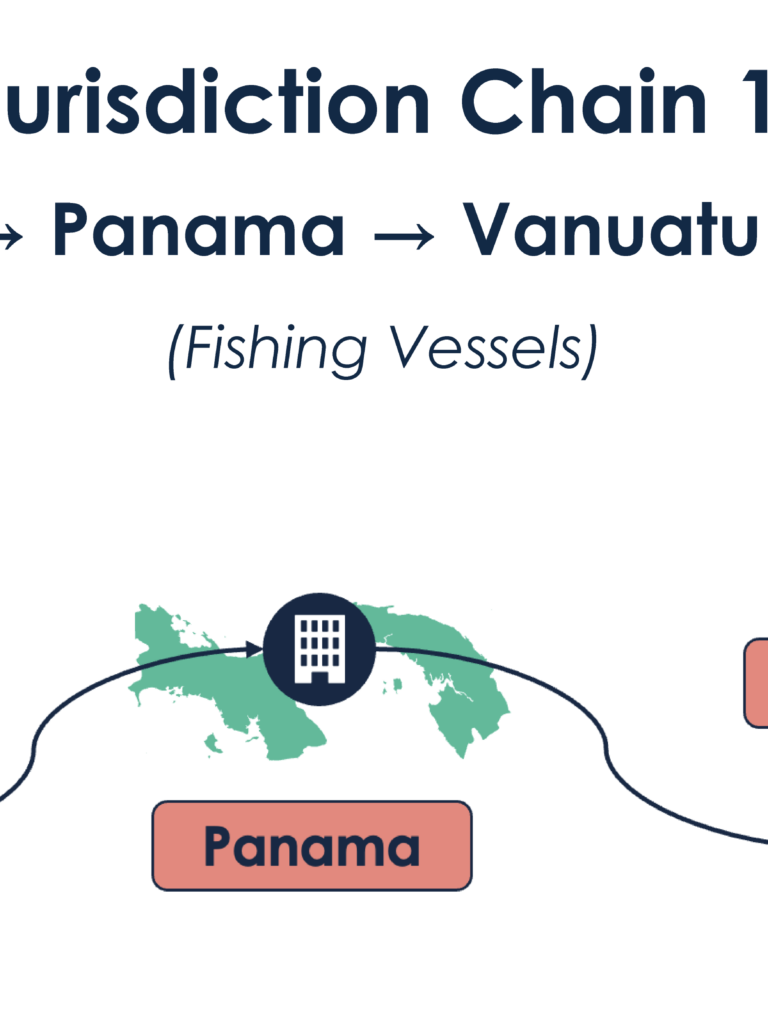
As of February 2026, at least 19 fishing vessels flagged to Belize share a common ownership structure: a registered owner in Vanuatu, a parent company in Panama, and an ultimate beneficial owner in Taiwan.[5] With the exception of Taiwan, none of these jurisdictions publicly disclose shareholders for locally registered companies, impeding UBO traceability.[6] Records show that all 19 vessels trace back to a single Taiwanese company, the Kaohsiung-based Gilontas Ocean Co., Ltd. (今隆達海洋股份有限公司), which operates its fleet through subsidiaries incorporated in Panama and Vanuatu.[7] These vessels fish for tuna in the high seas of the Atlantic just outside exclusive economic zone (EEZ) boundaries in northern South America, and are based in Paramaribo, Suriname, where Gilontas also appears to maintain a subsidiary.[8] Records show that Gilontas and its subsidiaries have historically registered vessels in Indonesia and Fiji as well.[9]
Complex jurisdiction chains often coincide with risky vessel behavior and crew safety issues. The Inter-American Tropical Tuna Commission (IATTC) added eight Georgia-flagged vessels linked to Gilontas to its IUU blacklist from 2005 to 2007, after identifying that they had fished without authorization and failed to report their catch in the IATTC convention area.[10] The rationale for IATTC’s 2007 removal of these vessels from the list is unclear.[11] While removal typically implies a change in ownership, S&P Global data indicates that Gilontas’ Panama entity owned and operated the vessels before, during, and after their IUU listing.[12] Separately, investigations by the BBC, Hakai Magazine, and Human Rights at Sea have linked Gilontas to the two vessels involved in the 2015 disappearance of American fisheries observer Keith Davis.[13] The case was never solved, but at the time of his disappearance, Gilontas entities in Panama and Vanuatu owned the refrigerated cargo ship VICTORIA NO. 168 (IMO 8808252), on which Davis was based, and the longliner CHUNG KUO NO. 818 (IMO 8652809), which was transshipping catch to the VICTORIA NO. 168 when Davis disappeared.[14] In both cases, layers of offshore incorporation made it difficult to establish clear accountability, and the fleet has continued to operate largely undisturbed.
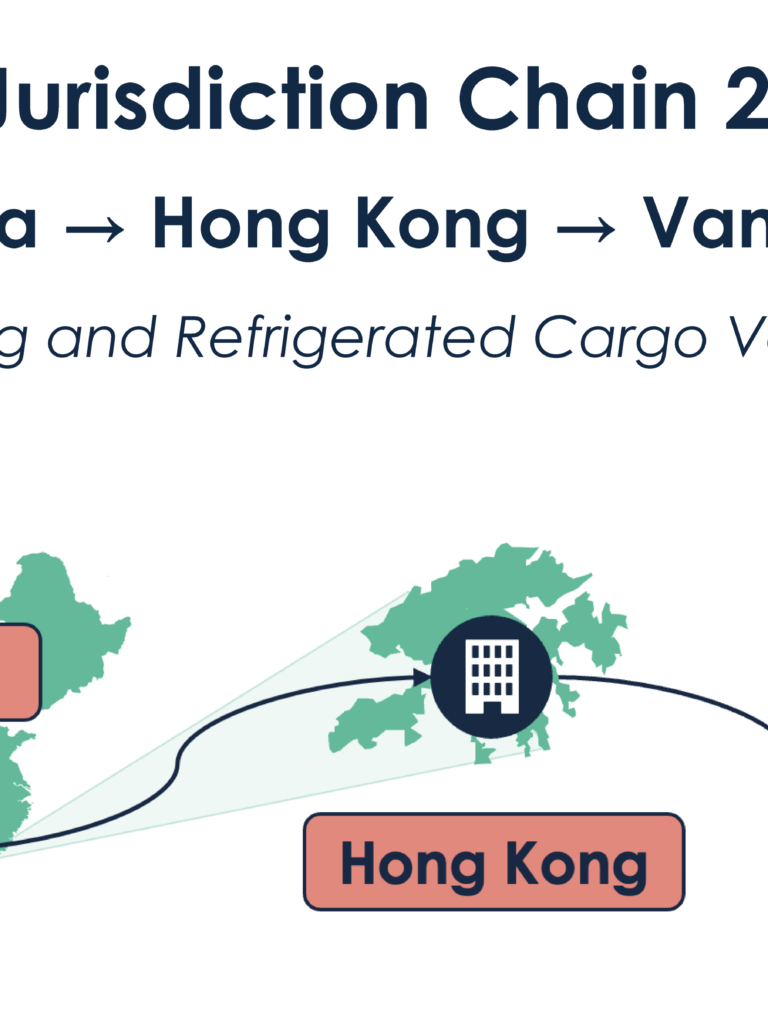
A growing number of Chinese-owned fishing and refrigerated cargo vessels are operating under the Vanuatu flag. According to S&P Global data, 30 such vessels were active as of February 2026; most declared intermediary owners in Hong Kong.[15] None of these ships flew the Vanuatu flag before November 2022, and more than
half registered in Vanuatu after October 2024.[16] At least 22 additional Vanuatu-flagged vessels with Mandarin names and similar reflagging timelines use Vanuatu-incorporated registered owners without declaring a parent company, bringing the potential total to 52 vessels.[17] All of the fishing vessels in question trawl for squid in the unregulated fishery of the Southwest Atlantic near Argentina.[18]
Multiple fishing companies operate under this pattern, but what appears to be the largest fleet is associated with Rongcheng Xinrun Aquatic Products Co., Ltd. (荣成市鑫润水产有限公司) (Xinrun), which reportedly owns at least 13 trawlers.[19] Corporate records indicate that, functionally, Xinrun’s PRC entity owns a Hong Kong entity, which owns a Vanuatu shell company that owns the vessels.[20] Since December 2024, Argentina’s navy has detected and fined two Chinese-owned, Vanuatu-flagged trawlers operating illegally within the Argentine EEZ.[21] A Xinrun-owned vessel was involved in one of the EEZ incursions, and the company shows other risk factors in its processing operations in China.[22] For example, unverified posts by an apparent migrant worker on Douyin, China’s domestic version of TikTok, allege food and lodging conditions “unsuitable for human beings” and physical violence toward laborers at a Xinrun-linked processing plant in Shandong province.[23]
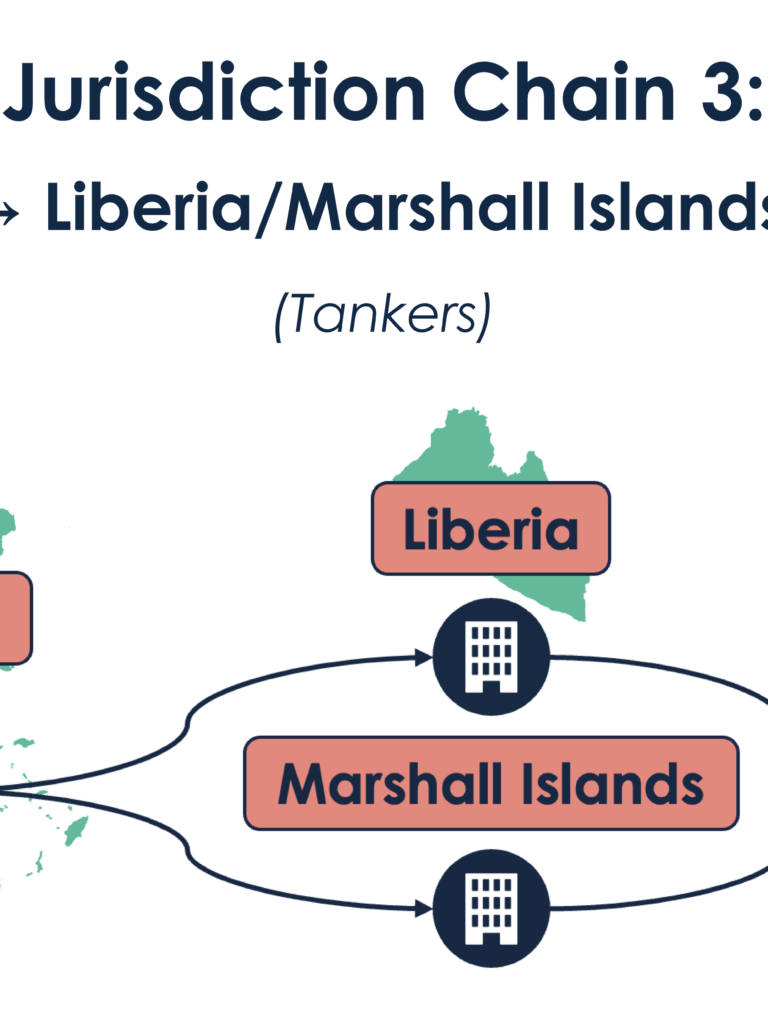
Greek shipowners often use Liberia and the Marshall Islands (RMI) as host jurisdictions for company incorporation.[24] As of February 2026, 419 tankers with declared beneficial owners in Greece had a registered owner in the RMI, and 404 had a registered owner in Liberia.[25] Both countries centralize maritime and corporate registration under a single body to facilitate easy registration for shipowners, but disclose almost no information on the companies registered there.[26] In the RMI, public corporate records exist, but all details beyond a registration date are confidential.[27] In Liberia, no records are available to the public; the corporate registry claims to provide entity verification documents via email inquiry, but a C4ADS attempt to request such documents went unanswered.[28] An additional 118 Greek-owned tankers in this group operate under the Maltese flag rather than the flags of their incorporation jurisdictions.[29]
In January 2026, Greek-owned tankers reportedly transported 35 percent of global Russian oil shipments.[30] Exposure to the Russian oil market makes these vessels vulnerable to U.S. and EU sanctions and incentivizes complex registration chains to minimize liability.[31] In early 2026, a European Commission proposal to replace the current price cap with a complete ban on the maritime transportation of Russian oil stalled due to opposition from Greece and Malta, which appear to benefit from this trade.[32] Since 2022, Greek shipowners have also sold dozens of old tankers into what has been referred to as Russia’s “shadow fleet,” in which beneficial ownership becomes almost entirely untraceable by design, systematically evading sanctions.[33]
The patterns documented here suggest that complex jurisdiction chains are integral enabling factors for multiple types of maritime offenses. IUU fishing, labor abuses, and sanctions evasion often occur within a similar infrastructure built on shell companies and flags of convenience. Addressing maritime crime requires treating beneficial ownership transparency not as an industry-specific issue but as a foundational maritime governance challenge.
[1] Mary Utermohlen, Austin Brush, and Duncan Copeland. Spotlight on Transparency: The Exploitation of Company Structures by Illegal Fishing Operators. C4ADS, December 10, 2020. https://c4ads.org/issue-briefs/2020-12-9-spotlight-on-transparency/.
[2] S&P Global Maritime Intelligence Risk Suite.
[3] Ownership of Fishing Companies, Vessels Needs Greater Transparency and Accountability. The Pew Charitable Trusts, October 17, 2023. https://www.pew.org/en/research-and-analysis/issue-briefs/2023/10/ownership-of-fishing-companies-vessels-need–greater-transparency-and-accountability.
[4] Claudia Deeg. “Why Knowing Who Owns What Matters: OECD’s New IUU Fishing Recommendation.” Global Fishing Watch, July 9, 2025. https://globalfishingwatch.org/article/why-knowing-who-owns-what-matters-oecds-new-iuu-fishing-recommendation/.
How Beneficial Ownership Transparency Can Help Identify EU Nationals Who Profit from Foreign Illegal Fishing Activities. EU IUU Fishing Coalition, June 19, 2024. https://www.iuuwatch.eu/2024/06/how-beneficial-ownership-transparency-can-help-identify-eu-nationals-who-profit-from-foreign-illegal-fishing-activities.
“Benefits of Using Beneficial Ownership Information in Fisheries Governance.” In Charting New Waters: Strengthening Fisheries Governance through Beneficial Ownership Transparency. United Nations Office on Drugs and Crime and Open Ownership, February 4, 2025. https://www.openownership.org/en/publications/charting-new-waters/benefits-of-using-beneficial-ownership-information-in-fisheries-governance/.
[5] S&P Global Maritime Intelligence Risk Suite; “Parent company” refers to the entity listed as “group owner” in S&P Global. Many fishing vessels do not report their group owners to the IMO, meaning that some jurisdictional chains do not emerge via scaled analysis of S&P Global ownership data.
[6] Belize, Vanuatu, Panama and Taiwan corporate records available upon request.
[7] S&P Global Maritime Intelligence Risk Suite.
“About Gilontas.” Gilontas Ocean Group (今隆達海洋股份有限公司). February 5, 2026, https://www.gilontas.com/.
Taiwanese, Vanuatu, and Panama corporate records available upon request.
[8] “ICCAT Record of Vessels.” International Commission for the Conservation of Atlantic Tunas (ICCAT). Accessed February 4, 2026. https://www.iccat.int/en/VesselsRecord.asp.
“Vessel Register.” Inter-American Tropical Tuna Commission (IATTC). Accessed February 4, 2026. https://www.iattc.org/en-US/Management/Vessel-register.
KangTai. “RE: Introductions and Observer Data Request for Atlantic Ocean LL Tuna FIP (Star Trading) Fishery Improvement Project Vessels.” Letter to Department of Agriculture, Livestock and Fisheries, Suriname, July 30, 2024. Published in Atlantic Ocean Tuna – Longline FIP profile. FisheryProgress. https://fisheryprogress.org/sites/default/files/documents_actions/Atlantic%20Ocean%20LL%20Tuna%20FIP%20%28Star%20Trading%29%20FIP%20-%20Engagement%20%26%20Observer%20Signed%20Data%20Request%20-%20Suriname_0.pdf.
AIS data from Global Fishing Watch.
[9] S&P Global Maritime Intelligence Risk Suite.
“Gilontas Indonesia To Set-Up Operations In Fiji.” Fiji Times, April 13, 2011. Republished in Atuna Archive. https://www.atuna.com/archive/?article=9535.
[10] “Combined IUU Fishing Vessel List.” Trygg Mat Tracking (TMT). Accessed February 10, 2026. https://iuu-vessels.org/.
“IATTC-IUU Vessel List.” Inter-American Tropical Tuna Commission (IATTC). Archived February 17, 2007. Wayback Machine, https://web.archive.org/web/20070217125051/https://www.iattc.org/IATTCIUUVesselListENG.htm.
“Annual IUU Vessel List – 30 June 2006.” IATTC, June 30, 2006. https://www.iattc.org/en-US/Vessel/GetPDFIUU?year=2006.
“Annual IUU Vessel List – 26 December 2005.” IATTC, December 26, 2005. https://www.iattc.org/en-US/Vessel/GetPDFIUU?year=2005.
“Document JWG-3-04: Identification of Vessels of Non-Parties Fishing in the Eastern Pacific.”IATTC, June 10, 2004. https://www.iattc.org/getattachment/bf8aca44-1761-49b4-a337-007bda427c87/JWG-03-04_Identification-non-party-vessels.pdf.
“Document JWG-3-07: List of Vessels Identified as Engaged in IUU Fishing.” IATTC, June 10, 2004. https://www.iattc.org/GetAttachment/43833c07-45ca-4862-be8d-974c1add463c/JWG-03-07_List-of-vessels-identified-as-engaged-in-illegal-unreported-and-unregulated-(IUU)-fishing.pdf.
[11] “Document JWG-7-05: Status of Nine Former IUU Longline Vessels.” IATTC, June 20, 2008. https://www.iattc.org/getattachment/4d84630f-cf2d-4396-988a-1e1e5b1be362/JWG-7-05_Status-of-nine-former-IUU-longline-vessels.pdf.
[12] “IATTC-IUU Vessel List.” IATTC. Archived February 17, 2007. Wayback Machine. https://web.archive.org/web/20070217125051/https://www.iattc.org/IATTCIUUVesselListENG.htm.
“Annual IUU Vessel List – 30 June 2006.” IATTC, June 30, 2006. https://www.iattc.org/en-US/Vessel/GetPDFIUU?year=2006.
[13] Sarah Tory. “The Mysterious Disappearance of Keith Davis.” Hakai Magazine, January 4, 2017. https://hakaimagazine.com/features/mysterious-disappearance-keith-davis/.
Investigative Report and Case Study: Fisheries Abuses and Related Deaths at Sea in the Pacific Region. Human Rights at Sea, December 1, 2017. https://media.business-humanrights.org/media/documents/files/documents/HRAS-Fisheries-Abuse-Investigative-Report-Dec-2017-SECURED.pdf.
“Keith Davis: He Was Protecting the Oceans – Then He Disappeared.” BBC News, September 5, 2022. https://www.bbc.com/news/world-us-canada-62603911.
[14] S&P Global Maritime Intelligence Risk Suite.
Panama corporate registry documents available upon request.
[15] S&P Global Maritime Intelligence Risk Suite.
[16] S&P Global Maritime Intelligence Risk Suite.
[17] S&P Global Maritime Intelligence Risk Suite.
[18] AIS data from Global Fishing Watch; workspace link available upon request.
[19] S&P Global Maritime Intelligence Risk Suite.
Chinese and Hong Kong corporate records available upon request.
[20] Chinese, Hong Kong, and Vanuatu corporate records available upon request.
[21] “Real-Time Intelligence Powers Argentina’s Fight Against Illegal Fishing.” Skylight, accessed February 9, 2026. https://www.skylight.global/news/argentina-success-story.
“Prefectura detectó un buque pesquero extranjero en la zona económica exclusiva de Argentina (Coast Guard Detected a Foreign Fishing Vessel in Argentina’s Exclusive Economic Zone).” iProfesional, January 12, 2026. https://www.iprofesional.com/actualidad/445868-prefectura-detecto-buque-pesquero-extranjero-en-zona-economica-exclusiva-argentina.
[22] “Prefecture Detected an Asian Vessel Fishing Illegally in Argentine Waters.” Agenda Malvinas, January 8, 2025. https://agendamalvinas.com.ar/en/noticia/prefectura-detecto-un-buque-asiatico-pescando-ilegalmente-en-aguas-argentinas.
[23] Chinese corporate records available upon request.
阿基瑞林 (Ajiruilin) (ajiruilin236). “不是我的亲身经历,我都不敢相信,在当今社会,还存在这么恶毒的工厂 (If it hadn’t happened to me personally, I wouldn’t have believed that such a vicious factory still exists in today’s society).” Douyin video, January 7, 2024. Accessed via search for 山东荣成市鑫汇水产有限公司 (Shandong Rongcheng Xinhui Aquatic Products Co., Ltd.). https://www.douyin.com/search/山东荣成市鑫汇水产有限公司; Douyin post details available upon request.
[24] 2025 Review of Maritime Transport: Staying the Course in Turbulent Waters. United Nations Conference on Trade and Development (UNCTAD), September 28, 2025. https://unctad.org/system/files/official-document/rmt2025overview_en.pdf.
S&P Global Maritime Intelligence Risk Suite.
[25] S&P Global Maritime Intelligence Risk Suite.
[26] Liberian and Marshallese corporate registry documents available upon request.
[27] “Corporate FAQs.” International Registries, Inc. (IRI). Accessed February 4, 2026. https://www.register-iri.com/corporate/corporate-faqs/.
[28] “Legal Entity Verification and Compliance.” Liberia International Ship & Corporate Registry (LISCR). Accessed February 10, 2026. https://www.liscr.com/corporate-registry/additional-services#legal-entity-verification-and-compliance.
[29] S&P Global Maritime Intelligence Risk Suite.
[30] “EU-Owned Tankers Ship 35% of Russia’s Oil in January Ahead of EU Ban.” Windward, February 9, 2026. https://windward.ai/blog/eu-owned-tankers-ship-35-of-russias-oil-in-january-ahead-of-eu-ban/.
[31] “EU-Owned Tankers Ship 35% of Russia’s Oil in January Ahead of EU Ban.”
Giacomo Tognini. “Meet the Greek Shipping Billionaires Getting Rich Off Russian Oil.” Forbes, May 13, 2024. https://www.forbes.com/sites/giacomotognini/2024/05/13/meet-the-greek-shipping-billionaires-getting-rich-off-russian-oil.
[32] “Greece and Malta Opposed the Ban on Russian Oil Transportation.” Nasha Niva, February 10, 2026. https://nashaniva.com/en/387775.
Alberto Nardelli and Ewa Krukowska. “Greece and Malta Hesitate Over EU’s Russia Oil Services Ban.” Bloomberg, February 10, 2026. https://www.bloomberg.com/news/articles/2026-02-10/greece-and-malta-hesitate-over-eu-s-russia-oil-services-ban.
[33] Robin Brooks and Ben Harris. “Where Did Russia’s Shadow Fleet Come From?” Brookings Institution, February 27, 2025. https://www.brookings.edu/articles/where-did-russias-shadow-fleet-come-from/.
Danai Maragoudaki and Eliza Triantafyllou. “Shadow Fleet Secrets: How Greek Tankers Were Used to Transport Russian Oil.” Solomon, July 2, 2025. https://wearesolomon.com/mag/format/investigation/shadow-fleet-secrets-how-greek-tankers-were-used-to-transport-russian-oil/.