Carved to Conceal
Zimbabwe’s convictions of two Chinese rhino horn traffickers are a real win, but the network behind them is still operating. C4ADS analysis links suspicious shipments from Zimbabwe to a web of Chinese logistics companies tied to one Guangzhou firm, showing why every seizure should be traced upstream.
This is the second installment our new series taking you inside C4ADS’ counter-wildlife trafficking work – our approach, the patterns we’re seeing, and where the opportunities for real impact lie.
In February 2025, Zimbabwean police arrested two Chinese nationals for allegedly attempting to ship rhino horn hidden inside a 13-kilogram owl statue from Harare’s Robert Mugabe International Airport to China. One of the two, Wang Lin, was already wanted for an October 2024 rhino horn seizure that involved the same method. The other, Wang Fuxi, had been convicted of ivory trafficking in a separate case in China in November 2015.[1] Months later, police in Harare arrested another Chinese national, Cong Yanzhong, who was carrying three rhino horns totaling 7.7 kilograms. By the end of 2025, Zimbabwean courts had sentenced Cong to 18 years in prison and, according to a local source, Wang Lin to nine years, a huge win for Zimbabwe that reflects its commitment to fighting wildlife crime and protecting its natural resources.
Most wildlife crime investigations end here: a successful seizure, arrest, and – when the system works as it did in Zimbabwe – conviction. The convictions of Cong and Wang Lin, suspected to be buyers of aggregated rhino horn with the means to traffic the product to end markets in China, likely helped close a vector vulnerability in the local supply chain. However, the network of actors and entities required to make a wildlife trafficking operation successful does not end with one individual or at Zimbabwe’s borders. C4ADS identified instances of the same trafficking method and traced transcontinental threads back into China. Five shipments from Zimbabwe to Shenzhen point to a web of low-profile logistics companies linked to a single Guangzhou-based logistics company that likely facilitated the import of rhino horn through ports of entry in Guangdong Province.
Chiseling Out the Guangdong Network #
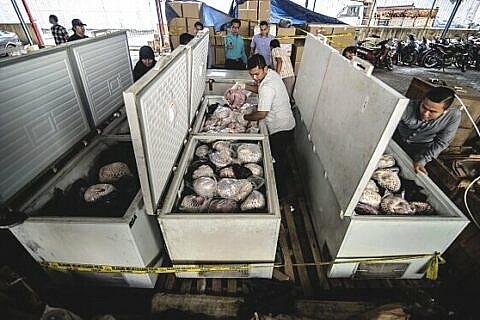
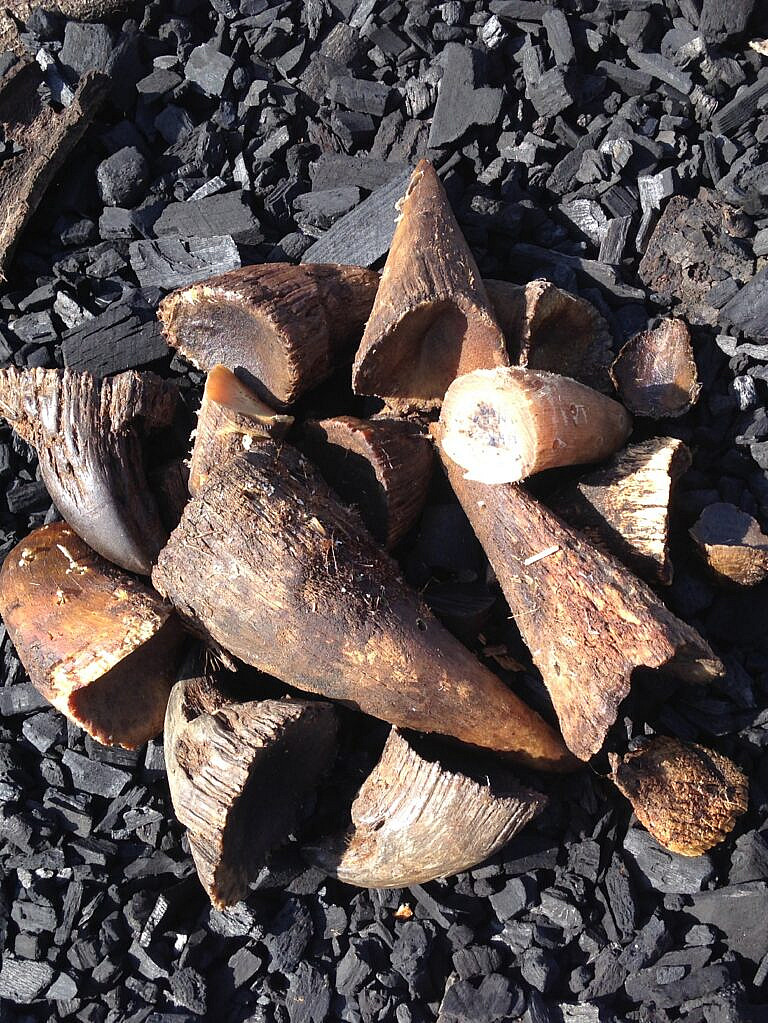
The method Wang Lin used is not new; it is one of the older tricks of the trade. In 2002, authorities in Singapore seized 6.2 tonnes of ivory originating in Malawi declared to contain “stone sculptures.” It was the largest illegal ivory shipment at the time and one of the earliest indicators that organized, transnational criminal activity in wildlife trafficking was a growing problem. According to U.S. prosecutors, the Moazu Kromah network concealed ivory and rhino horn within African traditional art, including masks and sculptures. Traffickers have also attempted to smuggle rhino horn to Asia by air, hidden inside sculptures.
Source: C4ADS Archives
C4ADS reviewed bill of lading-level data that matched the profile and time frame of Wang Lin’s trafficking method. The review identified nine Chinese consignees that had received shipments declared as “sculptures” or similar goods from Zimbabwe and other southern African jurisdictions between June 2023 and February 2025. Of particular interest were four shipments from Zimbabwe to Shenzhen between 2024 and 2025. Each of the four shipments listed a different Chinese company in Shenzhen as consignee, but also listed the same Chinese phone number as its associated contact.
The consignors of these four shipments used a mix of Zimbabwean- and Chinese-sounding names, likely falsified, and the consignees were all relatively nondescript logistics companies. One of the companies had a history of importing timber, stone products, and seafood – all commodities known to conceal trafficked wildlife[2] – from Vietnam,[3] and Chinese customs had previously cited it for undeclared imports of solid waste.[4] C4ADS also found two additional Chinese companies that shared addresses with some of these consignees. One of them had received shipments of semiprecious gems – another known concealment commodity[5] – from Tanzania,[6] and Chinese customs had previously cited it for misdeclared imports of seafood and animal products.[7]
The shared phone number on those four shipments links directly to a WeChat account under the name “Miss Guo” (郭小姐; Guo Xiaojie). The account holder remains unidentified, and the name may be an alias. However, the account also lists an email address that, according to an unofficial Chinese business registry, employees of a single Chinese logistics company use: Guangzhou Huayongcheng Supply Chain Management Co., Ltd (Guangzhou Huayongcheng).[8] C4ADS research shows that the registered owner of the phone number is Zhang Zhidong, who appears to go by the English name Don Zhang[9] and holds a 30% stake in Guangzhou Huayongcheng.[10] A fifth shipment to yet another Chinese logistics company declared as “stone sculptures” listed a separate Chinese phone number linked to a WeChat profile under the name “Miss Li” (黎小姐; Li Xiaojie), formatted identically to the “Miss Guo” profile listing a name, position, and work contact number, which suggests affiliation with Guangzhou Huayongcheng.
Map of Chinese logistics companies that received shipments from Zimbabwe declared as “sculptures” or similar goods in 2023-20235 and are linked by contact information to Guangzhou Huayongcheng Supply Chain Management Co., Ltd.
Since 2020, Guangzhou Baiyun International Airport and Shenzhen Bao’An International Airport, both in southern China’s Guangdong province, have together been linked to at least 79 publicly reported seizures of ivory, rhino horn, or pangolin scales.[11] Investigations by the Environmental Investigation Agency into Chinese wildlife trafficking syndicates have regularly identified Guangdong as an entry point for ivory, including at least one recent ivory seizure suspected to be associated with those same syndicates.
C4ADS also observed instances of a similar wildlife trafficking structure in Zimbabwe in previous years. In 2023, Zimbabwean authorities arrested another Chinese national, Wang Yang, along with his suspected local suppliers in a similar trafficking scheme. While Cong Yanzhong’s arrest did not reveal any additional leads, he likely operated using a method similar to Wang Lin’s. One or two agents in Africa, such as Wang Lin, can therefore rely on local suppliers and falsified identities to move rhino horn through networks like these to end markets in China.
Partial network of Chinese logistics companies that received shipments from Zimbabwe declared as “statues” or similar goods in 2023-2025, and their links to Guangzhou Huayongcheng Supply Chain Management Co., Ltd.
Based on the shared contact details, declared goods, and timing of these shipments, C4ADS assesses that a complex web of Chinese trading and logistics companies likely facilitated the import of rhino horn to China from Zimbabwe, with the representative of one company, Guangzhou Huayongcheng, at its center. The available evidence does not show whether the company, its shareholder, or any of the associated importers knew that the shipments from Zimbabwe may have contained rhino horn. However, the repeated pattern and the use of various nondescript trading and logistics companies for one-time shipments suggest that whoever arranged the shipments likely sought to conceal the end buyers.
Chipping Away at China’s Rhino Horn Ban #
China has banned rhino horn trade and use since 1993. A 2018 revision of the law would have allowed use by permit in “special circumstances,” including medicinal and scientific use, but China later postponed its implementation indefinitely. The postponement, which remains unresolved, possibly reflects indecision within the government. Despite the ban, seizure data and investigations show that demand for rhino horn in China for quasi-medicinal and recreational use persists. The weight and volume of rhino horn seized in, or reported to be destined for, mainland China have increased since 2023 from lows during the COVID-19 pandemic.[12] In a WeChat audio conversation that C4ADS translated, two Chinese nationals in southern Africa also claimed that rhino horn was the only major wildlife product still in demand in China. The speakers said that while imagery of poached animals in anti-trafficking campaigns has been effective for ivory, rhino horn demand reduction campaigns had not achieved the same impact.
Small, artisan-centered businesses remain a risk factor for rhino horn and ivory trafficking in China. C4ADS investigations have found that businesses of this type occasionally serve as cover for ivory trafficking. For example, Wang Fuxi, arrested with Wang Lin in Zimbabwe and later acquitted, operated a stone carving business in rural Hubei Province at the time of his 2014 arrest in China. Between late 2025 and mid-2026, authorities intercepted and seized multiple shipments of rhino horn across the Africa-Asia supply chain, typically originating in Angola or the Democratic Republic of Congo and in transit to Laos. Investigations by NGOs and journalists in Laos indicate that rhino horn often ends up in shops targeting Chinese tour groups – a new business model for trafficking it into China. Because rhino horn can technically grow back, Laos-based tourist shops reportedly market it and its derivatives as sustainable, with some success. Sellers in China may adopt a similar pitch. However, in practice, poachers find it far easier to kill a rhino for its horn.
Persistent demand and high prices will very likely continue to entice determined parties to poach and traffic rhino horn from African range states. Zimbabwe’s convictions of Cong and Wang Lin removed two suspected buyers from the supply chain, changing the risk calculus for would-be offenders and potentially closing a trafficking vector out of one southern African country. But arrests, and even convictions, are not the end of the line. Wang Yang, for instance, fled Zimbabwe after his arrest in 2023 and C4ADS’ sources confirm that he is currently wanted by INTERPOL. Moreover, C4ADS monitoring of unofficial Chinese business registries and trade data indicates that the logistics network identified by C4ADS remained active as of October 2026.
Every seizure and arrest leaves behind a thread, whether a shipping record, a phone number, or a company registration. This investigation followed one of those threads from an owl statue in Zimbabwe to a network of shipments linked to a logistics company in Guangzhou. But that kind of follow-through happens only on a case-by-case basis. One way to have a significant impact on wildlife trafficking is to follow these threads systematically for all court cases and seizures, starting with every major rhino horn seizure in southern Africa and mapping each one upward and outward to reveal the network behind it. Done consistently, this approach would help authorities in source countries and end markets focus on the companies and individuals that keep reappearing. It would also help close off the routes these networks rely on.
The data to do this already exists. The sustained investment does not.
Holding the Line
[1] Wuhan Intermediate People’s Court [湖北省武汉市中级人民法院], Criminal Judgment No. 00131 (2015) [中刑初字第 00131 号]. December 24, 2015.
[2] “C4ADS Wildlife Seizure Database,” Center for Advanced Defense Studies. Accessed October 15, 2026.
[3] Southern African and Chinese trade records, Trade Atlas, www.tradeatlas.com.
[4] Liantang Customs of the People’s Republic of China. Additional details available upon request.
[5] “C4ADS Wildlife Seizure Database,” Center for Advanced Defense Studies. Accessed October 15, 2026.
[6] Southern African and Chinese trade records, Trade Atlas, www.tradeatlas.com.
[7] Wenjindu Customs of the People’s Republic of China. Additional details available upon request.
[8] Unofficial Chinese business registry. Additional details available upon request.
[9] https://web.archive.org/web/20160403221413/http://hyc-import.com/kfzx/
[10] Unofficial Chinese business registry. Additional details available upon request.
[11] “C4ADS Wildlife Seizure Database,” Center for Advanced Defense Studies. Accessed October 15, 2026.
[12] “C4ADS Wildlife Seizure Database,” Center for Advanced Defense Studies. Accessed October 15, 2026.