Missing the Boat
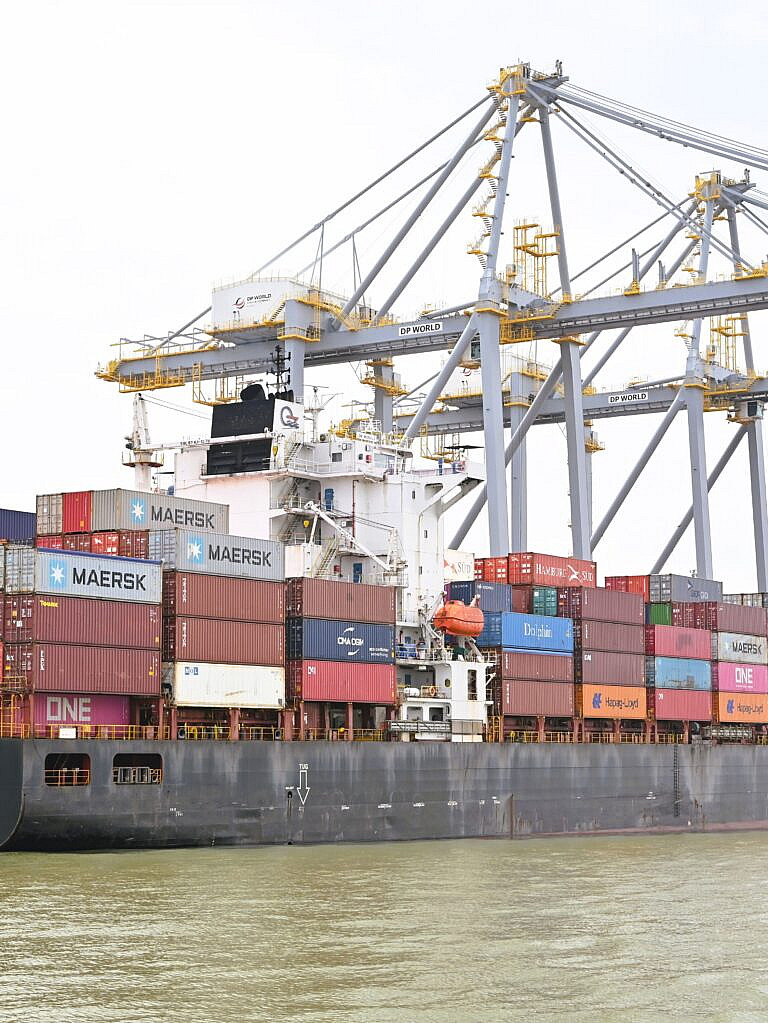
Port data can be used to catch what inspections miss: Beira is a known ivory and timber smuggling route with no recorded wildlife seizures, and screening shippers, agents, and routes against known trafficking networks could flag the next illicit shipment. Mozambique’s proposed port governing body and data platform is the chance to build in that screening from the start.
This is the third installment in our series taking you inside C4ADS’ counter-wildlife trafficking work.
In July 2022, Malaysian customs officials intercepted a container of sawn timber from Mozambique and found what they initially reported as six tonnes of ivory, along with rhino horn, pangolin scales, and big-cat teeth and claws. The shipment had crossed the Indian Ocean from southern Africa via Abu Dhabi, a common transit point for timber shipped from Mozambique. By the time authorities stopped it, the container was roughly 5,000 miles from the coast where it was loaded.
Ports are where trafficked goods, wildlife included, are easiest to hide and hardest to find. Roughly 80% to 90% of international trade by volume moves by sea, but customs authorities inspect an estimated 2% to 10% of containers at entry and exit points. Sealed containers let illicit goods ride alongside or even inside licit cargo, and a trafficker needs only the paperwork and seal to look ordinary. No port can inspect its way to detection. What ports need is a way to decide where to look, and the answer is already in the records they hold.
To see what this could mean in practice, consider Beira, Mozambique’s second-largest port. It offers one of the shortest routes to the sea for Zimbabwe, Zambia, Malawi, and the eastern Democratic Republic of the Congo (DRC). It also sits between two of the region’s major wildlife landscapes, the Great Limpopo Transfrontier Conservation Area and Niassa National Reserve. Its container terminal moved around 470,000 twenty-foot equivalent units in 2025 and is expected to grow, backed by investment from its operator and a US$160 million corridor and logistics-terminal upgrade financed by a Chinese consortium. Beira is a documented route for smuggled timber and minerals and often connects African poaching hubs to Asian markets.
C4ADS’ Wildlife Seizure Dashboard, which has compiled open-source seizure reporting since 2013, does not record a single wildlife seizure in the port of Beira. Maritime seizures — those in ports or aboard vessels — are rare everywhere, but given traffickers’ documented use of Beira, the gap likely reflects wildlife moving through the port undetected, and the port’s own trade records could help find it.
Beira Corridor

Only major routes to Beira are shown. Source: Tripartite Transport & Transit Facilitation Programme
Used but Not Caught #
Containerized sea freight is one of the main mechanisms of international wildlife trafficking. Ivory, in particular, often leaves Africa by sea in large shipments declared as timber. According to C4ADS analysis, traffickers used timber to conceal ivory or other wildlife products in at least 34 seizures of shipments from Africa since 2010. The Wildlife Justice Commission found timber convergence in 40% of the ivory cases it examined from 2017 to 2019.
As early as 2017, Oxpeckers identified Beira as one of Mozambique’s main timber-smuggling ports, reporting that shipping agents and customs officials colluded to send illegal hardwood to China. Timber linked to Islamic State Mozambique (ISM) reportedly moved through the port to China. Semiprecious stones and illicitly mined lithium from Zimbabwe reportedly followed the same route. Wildlife traffickers use Beira too. The Lilongwe Wildlife Trust listed Beira as one of the region’s known ivory export points, alongside Dar es Salaam, Pemba, and Durban.
Traffickers continue to hide ivory in licit and illicit timber shipments, likely including shipments moving from the DRC through Zambia and out of Beira. Arrests of wildlife traffickers in Malawi over the past decade suggest ties to Beira-based logistics providers. Yunhua Lin, convicted of wildlife trafficking in 2021, maintained relationships with logistics companies using the port of Beira. In another case, confidential sources reported that the ivory seized during the 2019 arrests of members of the Lin-Zhang wildlife trafficking syndicate in Lilongwe, Malawi, was part of a larger shipment intended for Beira.
Global Wildlife Seizures, 2013-2026: Proportion of Seizures by Transport Type
Source: C4ADS Wildlife Seizure Dashboard
Yet seizures of wildlife in and around Beira have come only from land and air interceptions. Seizure data analyzed by C4ADS indicates that this pattern is common. The Wildlife Seizure Dashboard includes over 8,400 seizures across 124 jurisdictions. Seizures in ports or aboard vessels made up 2% of incidents recorded between 2013 and 2026 but accounted for 49% of the total weight seized. These seizures tend to be large because traffickers often consolidate products into bulk shipments before they go to sea to save on transportation costs. Beira’s gap may reflect wildlife moving through the port undetected, seizures that went unreported, interdiction upstream at consolidation points, or little wildlife passing through at all. Collusion between shipping agents and customs officials, documented in the timber trade, is another possibility.
None of these explanations can be ruled out, and some shipments are likely stopped upstream as the 2019 Lilongwe arrests show. But evidence points toward wildlife likely passing through Beira undetected. No one should expect a port to be the main defense against wildlife trafficking. What a port has, however, is the records. Every shipment that passes through a port writes itself into the data: who sent it, who receives it, what it claims to be, and where it is going. Ports are where traffickers must leave a trace, but a trace helps only if someone reads it.
Wildlife Seizures in Mozambique, 2013-2026
Counts reflect where seizures were recorded, not where wildlife was sourced or destined. Each seizure is counted once. Seizures made outside Mozambique, that could not be tied to a specific area of Mozambique, or that originated in or passed through these areas are not included. A few records are known only at province or country level and are cited as such. Source: C4ADS Wildlife Seizure Dashboard
Reading Between the Bills #
Beira’s history shows what those records can reveal. In 2002, authorities in Singapore seized 6.2 tonnes of Zambian-sourced ivory that had moved by road through Lilongwe to Beira, then by feeder ship to Durban. Investigators believe Malawian trafficker Charles Kaunda moved the ivory overland to Beira. In 2013, authorities in Malawi intercepted a truck driven by Kaunda and his brother carrying 2.6 tonnes of raw ivory hidden beneath cement bags, bound for a container in Lilongwe, “to be exported on to Asia via the port of Beira.” Shipping records later tied Kaunda to 14 other containers sent along the same Lilongwe-Beira route to Singapore, Malaysia, and Indonesia between 2010 and 2015. Each used the same freight agent, a relative of Kaunda, and each was declared as sawn wood or semiprecious stones. None of the 14 is known to have been seized.
Routine container searches would have had to get lucky 14 times to catch these shipments. A screening process built on the pattern — same shipper, same agent, same route, same two declared commodities — could have flagged the next one.
Today the records are readable in close to real time. The United Nations Office on Drugs and Crime found that only 3% of ivory seizures came from routine inspection; the rest came from investigations, risk assessments, and tip-offs, suggesting that better targeting matters more than additional inspections. Targeting starts with what a shipment declares and who it names.
What it claims to be: A bill of lading declares what a shipment contains and where it is going. The most useful check is often the shipper’s history. A break from a shipper’s typical pattern — in commodity, destination, or volume — can flag potentially trafficked goods.
In March 2023, Vietnamese customs officials seized seven tonnes of ivory that an Angolan timber company had exported and declared as peanuts. Trade data from August 2022 through December 2023 shows that the company exported more than 150 shipments, mostly to Vietnam.[i] All but one declared timber products. The exception was the seized shipment, which declared “peanuts” but contained elephant ivory. Against its record, a single shipment of “peanuts” from a timber company stands out. Against a generic list of products shipped in a single day, it may not.
Who sends and receives it: Every bill of lading names a shipper and a consignee, and those names can be screened against lists of companies and individuals tied to past seizures and arrests. The details behind the names often tell more than the names themselves: an address shared with unrelated firms, a contact number recurring across supposedly separate consignees, a company name that matches no registered business. Combined with a screening list, each of these can link a routine-looking shipment to a known trafficker, and each is visible in the records.
Intermediaries can make the check harder. Freight forwarders and other logistics providers handle much of the world’s container trade, and most operate in good faith, using documents supplied by others in the supply chain. Trafficking networks have exploited that reliance, sometimes without the forwarder’s knowledge and sometimes through a few complicit employees. Bills of lading for shipments from Beira typically name logistics or freight forwarding companies. That is normal business practice and not by itself a sign of illicit activity, but it allows the real buyer to drop out of the record. Even then, the details remain checkable. C4ADS’ investigation of rhino horn shipments from Zimbabwe to China, which began with an arrest in Harare, traced names and a phone number shared across consignees in a logistics network spanning two countries. Added to a screening list, those shared details could flag additional shipments while they are still in port.
Ownership records can push the checks further. Companies that look unrelated on a bill of lading can share directors, shareholders, registered addresses, or legal representatives, revealing a larger network worth screening. Ports cannot do that tracing alone. It requires cross-jurisdictional analysis that connects seizures to arrests and networks, and then turns those findings into actionable lists that ports can screen against. Automated detection systems proposed for pilot programs at ports could recognize patterns and anomalies in shipment data. Paired with outside analysis, those flags can become cases.Those cases, when shared, can sharpen targeting at all levels of the supply chain.
Already on File #
None of this is unique to Beira or Mozambique. Any large transit port handling any trafficked commodity faces the same trade-off: The trade is too large to search and too valuable to slow down. The answer is to prioritize more effectively, using shipper history, agent networks, and route patterns to decide where to look. When no single entity is accountable for the whole chain, a trafficker needs to exploit just one weak link in the structure.
Mozambique is debating a fix for that structure at Beira, with a proposed single governing body for the port and a corridor-wide data platform. A new governing body accountable for the whole chain could build record-based screening from the start. No single country holds enough data to see these connections at scale. Training and data sharing among agencies, governments, regional bodies such as the Southern African Development Community, and NGO partners could help turn isolated seizures into coordinated, cross-border action. The records are already there. The goal is to make them usable.
Holding the Line
Carved to Conceal
[i] Trade Atlas Records, Accessed November 2026